2. THEORETICAL FOUNDATIONS
2.1. Balanced relation
The equilibrium data and mass balances are used to determine the number of stages of equilibrium, to find the necessary theoretical plates or transfer units required for a separation determined.
Dalton's law sets that a gaseous mixture, each gas exerts its own pressure as if there were other gases present. This pressure is called partial pressure, Pi, pressures if the gases occupy all volume of the mixture at the same temperature:
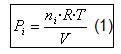
Where:
Pi: partial pressure of gas.
ni: moles gas.
R: ideal gas constant.
T: temperature.
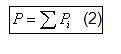
This expression has its utility since the total pressure, P, the mixture is the sum of all partial pressures.
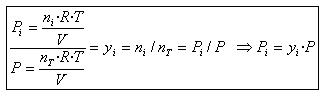
Therefore, if we divide equation (1) between the ideal gas law is obtained:
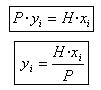
Recalling Henry's law:

With these two laws can be concluded: